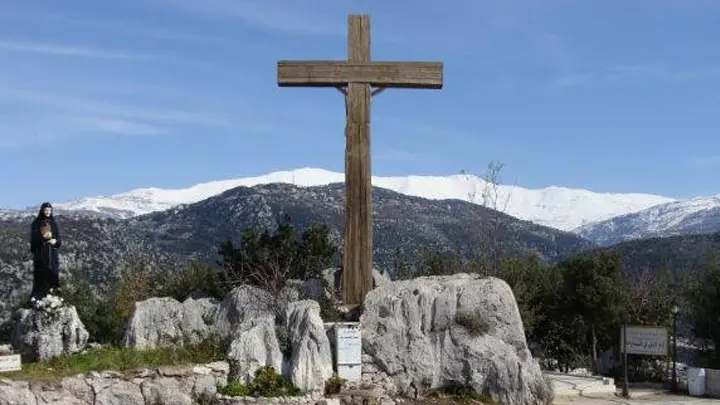
The raised wooden cross on the hill, with the statue of Saint Rafka and Mount Sannine under snow.

Shrine of Saint Rafka

Saint Rafka – Hemlaya

The village where an orphan girl traced her path to God, and the hill where she prayed as a child.

Discover her life Plan your visit

Gospel of the day

The daily Gospel and meditation, following the Maronite liturgical calendar.

Thursday, August 27 : Holy Gospel of Jesus Christ according to Saint Matthew 24,42-51.

Jesus said to his disciples: "Stay awake! For you do not know on which day your Lord will come.
Be sure of this: if the master of the house had known the hour of night when the thief was coming, he would have stayed awake and not let his house be broken into.
So too, you also must be prepared, for at an hour you do not expect, the Son of Man will come.
Who, then, is the faithful and prudent servant, whom the master has put in charge of his household to distribute to them their food at the proper time?
Blessed is that servant whom his master on his arrival finds doing so.
Amen, I say to you, he will put him in charge of all his property.
But if that wicked servant says to himself, 'My master is long delayed,'
and begins to beat his fellow servants, and eat and drink with drunkards,
the servant's master will come on an unexpected day and at an unknown hour
and will punish him severely and assign him a place with the hypocrites, where there will be wailing and grinding of teeth."

Meditation

Dearest Brother in Christ, the gentle Jesus—I, Catherine, servant and slave of the servants of Jesus Christ, write to you in His precious blood, desiring to see you a just lord in the exercise of the power entrusted to you. (…)

One must be just, and justly guard the city of one’s soul by living in the true and holy fear of God; one must love virtue and detest vice. In this way, we shall taste the blood of the crucified Jesus; true and holy justice will shine within you, and you will be a just and good master to your soul and to your neighbor—but not otherwise. That is why I told you I desired to see you a just master: so that, living justly, you might uphold right and justice in the office you hold.

My dearest Brother, sleep no longer; shake off your slumber with zeal. Let us return to ourselves and not wait upon time, for time does not wait; time moves faster than we imagine. I would have us step out of our current state and break the bonds that tie us; for he who is bound cannot move forward, and we must advance along the path of virtue by following the teaching of the crucified Jesus—who is the Way, the Truth, and the Life. Whoever follows Him does not walk in darkness but in the light. We must, therefore, walk in this gentle and straight path.

Prayer

Lord, increase our faith, and let us trust in you in every circumstance, as Saint Rafka did.

Source: Evangelizo — evangelizo.org

The life of Saint Rafka

“In union with your Passion, O Jesus.”

Rafka Pietra Choboq Ar-Rayès (1832–1914) was a Lebanese Maronite nun who bore blindness, paralysis and constant pain for almost thirty years, offering her suffering for the Church. She was the first woman of the modern Maronite Church to be raised to the altars.

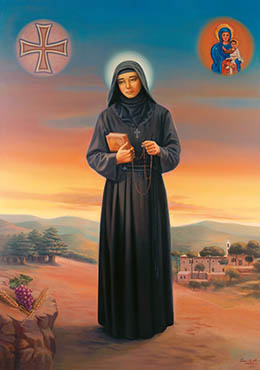
The official icon of Saint Rafka, holding the Gospel book and a rosary, with the Maronite cross and Our Lady of Deliverance.
  1. 1832

    Birth and baptism

    Boutrossieh — the feminine form of “Peter” — was born on 29 June 1832 in Hemlaya, in the North Matn highlands of Mount Lebanon, the only child of Mourad Saber el-Choboq el-Rayès and Rafka Gemayel. She was baptised on 7 July 1832 in the church of Mar Gerges (Saint George) in the village.

  2. c. 1839

    An orphan on the hill

    The death of her mother when she is about seven leaves her an only child alone with her father. She grows up among the rocks, oaks and wildflowers of the hill above Hemlaya, where she spends long hours in prayer.

  3. 1843–1847

    Service in Damascus

    Hardship obliges her father to send her, aged about eleven, into domestic service in Damascus, in the household of Assaad al-Badawi. She returns to Hemlaya four years later, in 1847.

  4. c. 1859

    The convent of Bikfaya

    Wishing to give herself wholly to God, she enters the Convent of Our Lady of Deliverance in Bikfaya and joins the Congregation of the Mariamettes (Daughters of Mary). Its founder calls her “the lily of Hemlaya”.

  5. 1861–1871

    Habit, vows and service

    She receives the religious habit on 19 March 1861 and makes her first vows the following year. She works in the kitchen of the Jesuit seminary of Ghazir, teaches catechism in Deir el-Qamar — sheltering a child during the events of 1860 — and helps run a girls’ school in Byblos and Maad.

  6. 1871–1872

    The Lebanese Maronite Order

    When her congregation is dissolved, she is guided to the Lebanese Maronite Order. On 12 July 1871 she enters the Monastery of Saint Simon el-Qarn in Aitou; she makes her perpetual vows on 25 August 1872 and takes her late mother’s name, Rafka.

  7. 1885

    Sharing the Passion

    In October 1885, at prayer, she asks to share something of Christ’s suffering. A violent pain seizes her head and right eye. When treatment fails, an American physician removes the eye without anaesthesia; she repeats only, “In union with your Passion, O Jesus.”

  8. 1897

    Monastery of Saint Joseph, Jrabta

    She is transferred to the Monastery of Saint Joseph al-Dahr in Jrabta, in the Batroun district, where she will live her last seventeen years.

  9. 1899–1914

    Blindness and paralysis

    By 1899 she is completely blind. Paralysis follows, with a dislocated shoulder and hip that leave her bedridden — yet her hands still knit, and she never ceases to give thanks.

  10. 1914

    A holy death

    Saint Rafka dies on 23 March 1914, Ash Monday, after receiving Communion, murmuring: “Jesus, Mary, Joseph — I give you my heart, my being and my soul.” Her relics are placed in the monastery chapel on 10 July 1927.

  11. 1985 & 2001

    Beatification and canonisation

    Declared Venerable in 1982, she is beatified by Pope John Paul II on 17 November 1985 and canonised in Saint Peter’s, Rome, on 10 June 2001, proposed as a model of the adoration of the Eucharist. Her feast is kept on 23 March.

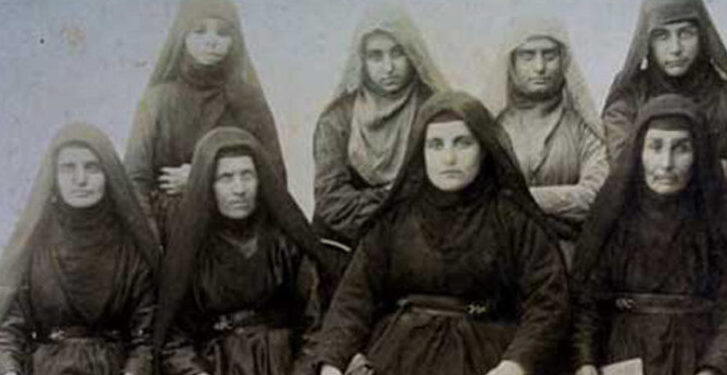
The Mariamette sisters in the nineteenth century; Rafka joined the congregation around 1859.
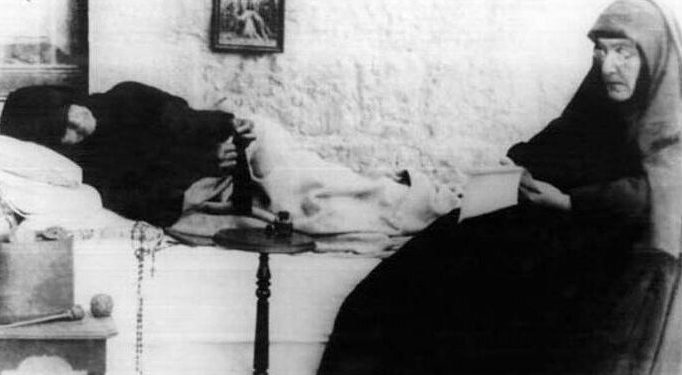
Saint Rafka bedridden in Jrabta, cared for by a fellow sister, in the last years of her life.
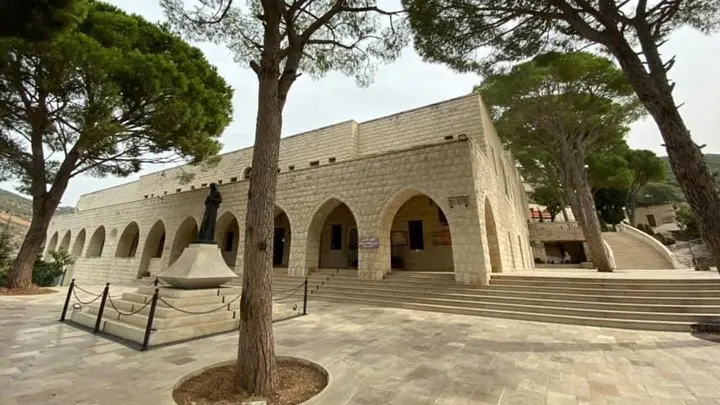
The Monastery of Saint Joseph al-Dahr in Jrabta, where Saint Rafka died and where her relics rest.

“With you, O Jesus.” This was her answer to every pain, through twenty-nine years of blindness and sickness.

Saint Rafka is invoked by the sick and by those who have lost their parents. She offered her long night of pain for the Church and for Lebanon. The hill.

Graces and miracles

Favours attributed to the intercession of Saint Rafka.

The accounts below are testimonies gathered at the shrine. Two healings were examined and recognised by the Church: that of Elizabeth En-Nakhel (uterine cancer, 1938) for the beatification, and that of the infant Céline Sami Rebeiz for the canonisation.

Céline Sami Rebeiz

The healing of this child, gravely ill, was the miracle recognised by the Church for the canonisation of Saint Rafka on 10 June 2001.

Alain Bou Jaoudé

Aged 15, he underwent abdominal surgery and afterwards developed severe jaundice and could no longer eat or drink. He recovered through the intercession of Saint Rafka.

Fouad Joseph al-Asmar

From Al-Kenīseh, Matn, he suffered disabling back pain for sixteen years that doctors could not explain, and was completely relieved after praying to Saint Rafka.

Fouad George Khoury

From Hadath, Baabda, he was left with paralysis of his left hand and legs after an operation, and regained movement through her intercession.

Rita Fadoul

Her daughter Karine, aged 8, was struck by a dangerous virus, with bleeding and an enlarged heart. After the doctors had given up hope, the family turned to Saint Rafka and the child recovered.

Mary Haddad

Her granddaughter Morgan, aged two, would lose consciousness and turn blue. After prayer through the intercession of Saint Rafka, she returned to normal health.

Abir Bechara Hajjar

From Qab Elias, Bekaa. Her daughter Elyse was born on 10 June 2001, the day of the canonisation. In 2002 Abir fell ill and her husband contracted a grave disease; after a visit to the shrine, he was healed.

Mando Elias Mikhael Rustom

From Rachiine. Aged eighteen months, he was diagnosed with leukaemia. After prayer through the intercession of Saint Rafka, his condition improved and his tests returned to normal.

Saint Rafka carried to Mass

One year, on the morning of the feast of Corpus Christi, Mother Ursula came into Sister Rafka’s room and asked how she was. “Thanks be to God, always,” she answered. “If only I could attend Mass on this holy day.” The superior asked whether she could sit, so the sisters might carry her to the church — and so, unable to walk, she was borne to the altar to be near the Body of Christ.

The hill of Saint Rafka in Hemlaya

“Here I traced my path.”

I remember nothing of my childhood in my village of Hemlaya but that wonderful hill, where I spent hours praying and contemplating the beauty God had made, looking out over the Valley of the Cross and Mount Sannine. There I felt Jesus with me, beside me, speaking to me; he was my mother and my father, and I a small orphan. My home was the rugged rocks, the oaks and the flowers. There I asked for the heart of Jesus; there I made my decision and traced my path for him.

Words of Saint Rafka in the last hours of her life, March 1914.

The hill is the little house that Saint Rafka built in her heart after she was orphaned — the place to which she withdrew to pray. Today its path is marked by a series of stations.

  1. 1

    The Raised Cross

    On the highest rocks of the hill hangs the Crucified, overlooking the whole site, a sign of the pain that Saint Rafka bore. It is among the largest wooden crosses in the world.

  2. 2

    The Last Hour

    At the Monastery of Saint Joseph in Jrabta, Mother Ursula asked Saint Rafka to tell her story before she died. Rafka raised her hand, remembered the hill, and said: “Here I traced my path.”

  3. 3

    Grotto of Our Lady of Deliverance

    It recalls the death of her mother when she was a child, and the hand of Our Lady of Deliverance, who became her second mother. A great rock bears the image of Our Lady, and a trickle of water flows from it — a sign of a mother’s giving.

  4. 4

    The Apparition of Jesus

    Among the rocks a statue of the Heart of Jesus meets a statue of a small girl, “Boutrossieh” — what Saint Rafka felt on the hill. The words read: “On earth as it is in heaven.”

  5. 5

    The Icon Chapel

    A small chapel with walls of natural rock, an altar surmounted by the icon of Saint Rafka, and three windows looking out over the valley of the River of the Cross.

    Here I traced my path on the awe-filled hill,
    here I wrote my life for Jesus my beloved,
    from beyond the heights, in his hand and mine,
    from Mount Sannine to the Valley of the Cross.

  6. 6

    The Way of the Cross

    A stairway marking the stations of the Way of the Cross. At the summit stands the cross, and beneath it a small cave where Saint Rafka would shelter from the winter. Above its entrance is written: “For thine is the kingdom, the power and the glory.”

  7. 7

    The Spring of Love

    A column of water rising from the earth toward the sky, a sign of giving and of goodness, in a view that gathers Mount Sannine, the valley of the River of the Cross and the whole hill of Saint Rafka.

You can be a friend of the hill: care for it, protect its environment, plant and tend it. It is a trust from Saint Rafka — a place where a small girl decided to sow a message of love, sacrifice and faith across the whole earth.

Hemlaya

In the heart of Mount Lebanon.

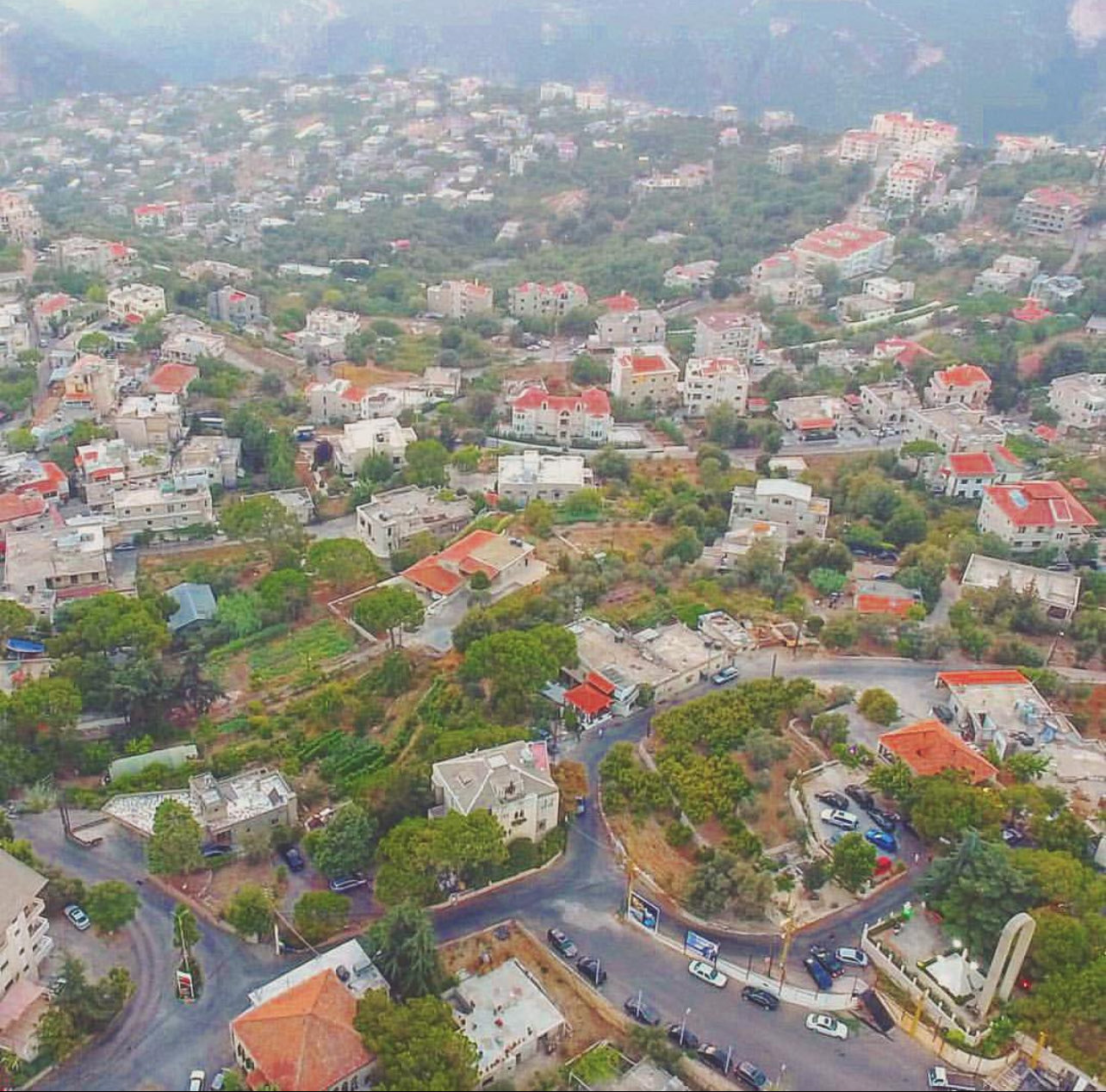
On one of the loveliest slopes of Mount Sannine, the village of Hemlaya lies in the North Matn, about 30 km from Beirut and 4 km from Bikfaya, at 850 metres above sea level.

Over an area of 1.2 million square metres it counts around 300 houses and close to 2,000 residents. It is a significant summer resort, with cafés, restaurants, sports and cultural clubs, and the “Lily of Hemlaya” clinic.

Aerial view of the village of Hemlaya, spread across the slopes of Mount Sannine.
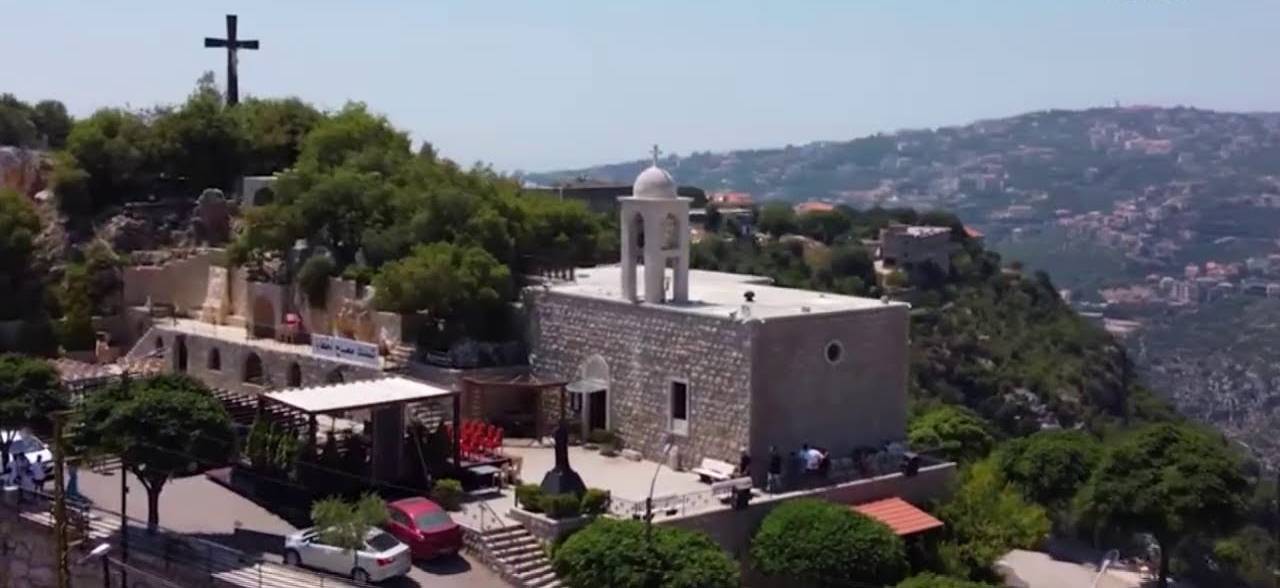
Aerial view of the hilltop church of Saint Rafka in Hemlaya, with its cross and bell tower.

The lie of the land

Hemlaya is a village where heritage and modern life meet. Its eastern lands border those of Abou Mizan; to the south lies Ain el-Kharroubeh, to the west Sfaileh, and to the north the course of the River of the Cross, which separates it from Deir Chamra.

Origin of the name: Either Syriac, meaning “the barns and storehouses”, or “Hima Layya” — the domain of a princess said to have lived between Daraya and Hemlaya.

The families of Hemlaya

El-Rayès, El-Raï, El-Chabaq, Abou Chabl and many other families, alongside newer residents in the modern apartments.

The tourist forest

A large wooded slope drops some 300 metres from the village to the Valley of the Cross, sought out by walkers and adventurers.

“Lily of Hemlaya” clinic

It provides health care for the people of the village and the neighbouring hamlets.

The churches of Hemlaya

The churches in which Saint Rafka was baptised and prayed.

Old church of Mar Gerges (Saint George)

A historic church built about 500 years ago. Here Saint Rafka received the sacrament of baptism on 7 July 1832.

New church of Mar Gerges

Built in 1905, above the old church. Masses and feasts are celebrated here.

Church of Mar Elias (Saint Elias)

Built in 1909, serving the parish. Its feast is celebrated on 20 July each year.

Feasts and anniversaries at Hemlaya

  • 23 March Feast of Saint Rafka
  • 23 April Feast of Saint George
  • 10 June Anniversary of the canonisation
  • 29 June Birth of Saint Rafka
  • 7 July Anniversary of her baptism
  • 20 July Feast of Saint Elias
  • 25 August Anniversary of her perpetual vows
  • 17 November Anniversary of the beatification

The parish and its priests

News and life of the parish of Hemlaya and the Shrine of Saint Rafka.

Father Gaby Matar

Parish priest of Mar Gerges (old and new) and the Shrine of Saint Rafka, Hemlaya.

Father Mirab Sleiman Hakim

Assistant priest for Mar Gerges (old and new), Mar Elias and the Shrine of Saint Rafka.

Visiting the shrine

You are welcome in Hemlaya, in the North Matn.

Opening hours

Shrine and church
Every day, 8:00 – 18:00
Sunday Mass
10:30

Getting here

  • From Beirut: Beirut – Antelias – Bikfaya – Hemlaya.
  • From Zouk Mosbeh: Kesrouan – Daraya – Hemlaya.
  • From Batroun: the coastal highway, then turn toward Hemlaya.

Good to know

Location
Hemlaya – North Matn – Mount Lebanon
Altitude
850 metres above sea level
Parking
Available on site
Admission
Free

Souvenirs

For more information and details about the souvenirs available, please contact Georgette Rahy at +961 3 873 089.

Church of Saint Rafka, Hemlaya — North Matn, Mount Lebanon.  ·  Open in Google Maps

Contact us

We welcome your questions and messages.

You can also write to us directly at [email protected].